Is At-Home Laser or Electrolysis Right for You?
If you are choosing between laser & electrolysis hair removal at home, start with the match, not the marketing claim. IPL or laser-style devices usually make more sense for reducing dark hair over larger areas, while electrolysis is better for a few individual hairs, especially when the hair is blonde, gray, white, or otherwise poor for light-based treatment.
At-home laser vs electrolysis at a glance
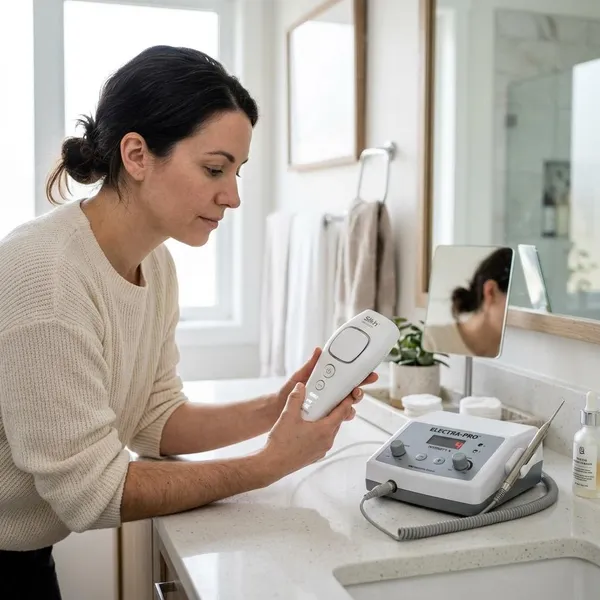
The fastest way to decide is to check three things in order: the size of the area, the color of the hair, and whether your skin tone is approved for the device. A big area with dark hair usually points toward IPL or an at-home laser-style device. A tiny area with light or stubborn hairs points more toward electrolysis, often professional electrolysis if you want dependable precision.
| If your main concern is... | Usually the better fit | Why it matters |
|---|---|---|
| Legs, arms, or broad reduction | IPL or at-home laser-style device | Covers more skin quickly enough to repeat consistently |
| A few chin, upper-lip, or stray body hairs | Electrolysis | Targets individual follicles instead of flashing a whole patch |
| Dark hair on an approved skin tone | IPL or laser-style device | Light-based devices need pigment contrast to work well |
| Blonde, gray, white, or many red hairs | Electrolysis | Hair color is less of a barrier |
IPL or laser for larger areas
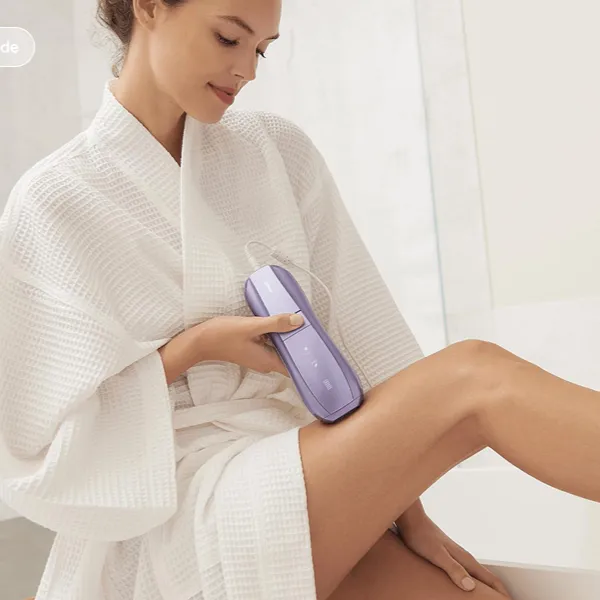
For legs, arms, underarms, and some bikini-line use, IPL or an at-home laser-style device is usually the practical choice. The treatment window covers a small patch of skin at a time, so a full routine feels possible rather than endless.
This matters if you are planning long-term use. A device that takes too long will probably end up in a drawer, even if it is technically effective. For dark hair on compatible skin, steady repeated sessions are usually more realistic with a light-based device than with hair-by-hair treatment.
Electrolysis for individual hairs
Electrolysis is the detail tool. It makes sense when the problem is not "I want smoother legs," but "these three chin hairs keep coming back."
- Good use case: a few visible hairs on the chin, upper lip, nipple area, or another small spot.
- Poor use case: trying to clear both legs or dense underarm growth one follicle at a time.
- Best expectation: slow, careful work rather than fast coverage.
Light-based devices for pigmented hair
IPL and laser-style devices need enough pigment in the hair to absorb the light. Black and dark brown hair usually gives the best match, while blonde, gray, white, very light red, or soft peach-fuzz hair often responds poorly.
If you have already tried a light-based device and saw almost no change after using it correctly, hair color may be the issue rather than your effort. In that situation, doing more sessions on unsuitable hair is unlikely to fix the mismatch.
Electrolysis for all hair colors
Electrolysis does not rely on visible hair pigment in the same way, so it can be a better route for blonde, gray, white, and some red hairs. That is why it often becomes the more sensible choice for pale facial hairs that IPL barely notices.
The limit is practicality. Home electrolysis can be slow and technique-sensitive, so it is best treated as a small-area option. For important facial work or hairs that bother you a lot, a trained professional is usually the safer and more dependable route.
Key differences between laser and electrolysis
The real difference is not simply "which one is stronger." Light-based devices are about coverage and reduction; electrolysis is about follicle-by-follicle precision. Once you see that split, the choice becomes less confusing.
Large-area speed
IPL and at-home laser-style devices are much faster for large areas because they treat a small zone of skin with each flash. That makes them a better fit for someone who wants to reduce hair on both legs before summer, or keep arm and underarm growth lighter throughout the year.
Hair color compatibility
Hair color can decide the method before anything else. Dark coarse hair usually gives light-based devices something to target. Very light hair often does not.
Skin tone compatibility
Many IPL devices need contrast between the hair and the surrounding skin. If your skin tone is outside the approved range, the risk of burns, irritation, or pigment changes can rise, and the device may not be appropriate.
Before buying, check the brand's skin tone chart for the exact model, not just the product category. If your tone sits near the edge of the approved range, treat that as a reason to be more conservative with settings, patch testing, and expectations.
Treatment precision
Electrolysis wins when you want to treat one hair at a time. It is useful for small visible hairs where you do not want to flash a larger patch of skin.
Light-based devices are less exact, but that is also their strength. They are made for coverage. If your goal is general reduction rather than clearing a single stubborn follicle, precision matters less than repeatable sessions.
Maintenance and permanence
At-home IPL and laser-style devices are usually better described as hair reduction tools. Regrowth can slow and become lighter for some users, but maintenance sessions are still common.
Electrolysis is more closely associated with permanent hair removal because each follicle is treated individually, especially in professional settings. At home, results depend heavily on the device, technique, and patience, so it is safer to avoid expecting clinic-level outcomes from a small consumer tool.
At-home convenience
IPL is usually the easier home habit. If you can treat an area quickly, follow a schedule, and see gradual reduction, it fits normal grooming better than a slow follicle-by-follicle method.
- Choose IPL or laser-style treatment if the area is broad, the hair is dark, and your skin tone is approved.
- Choose electrolysis if the area is tiny, the hairs are light, or precision matters more than speed.
- Use both carefully if IPL reduces most hair but leaves a few visible leftovers.
Which option fits different body areas?
Body area changes the answer because the same method can be sensible in one place and awkward in another. Size, sensitivity, visibility, and hair color all matter.
Legs and arms — IPL or laser
Legs and arms are usually the clearest case for IPL or an at-home laser-style device. They are large enough that electrolysis would be unrealistic for most people, and many devices are designed with wider windows or glide modes for this kind of use.
This is also where patience matters in a practical way. If you want smoother legs for one holiday next week, a light-based device is not an instant fix. If you are willing to use it regularly over time, it can be a more convenient long-term reduction tool.
Underarms and bikini line — IPL or laser
Underarms and the outer bikini line often suit IPL or laser-style devices when the hair is dark and coarse. The areas are smaller than legs, but individual-hair treatment would still be tedious for most people.
Read the area restrictions carefully here. Some devices allow the bikini line but not deeper intimate skin, and some settings may be too strong for sensitive areas. If the manual draws a boundary, stay within it.
Face — depends on hair color and device
Facial hair needs a more cautious choice. Dark coarse hair on the upper lip, chin, or jawline may respond to an IPL device if that device is approved for facial use. Fine peach fuzz, blonde hairs, gray hairs, or white hairs are much less likely to be a good match.
- Dark coarse facial hair: consider an approved facial IPL attachment or setting.
- Pale or gray facial hairs: electrolysis is usually more suitable.
- Near the eyes: avoid guessing; many devices are not approved there.
Small stubborn hairs — professional electrolysis
For a few hairs that keep returning after shaving, tweezing, waxing, or IPL, professional electrolysis is often the cleanest solution. It is especially worth considering when the hairs are very visible, light-colored, or in a sensitive area where repeated home experiments could irritate the skin.
Home electrolysis may be acceptable for minor touch-ups if you are careful and the device instructions fit the area. For anything hard to see clearly, painful, inflamed, or emotionally frustrating enough that you keep over-treating it, getting professional help is usually the better judgment call.
Safety and limitations
Safety comes down to using the right method on the right skin, hair, and body area. The biggest mistake is trying to force a device to work outside its intended range because the promise sounds appealing.

Burns and pigment changes with light-based devices
IPL and laser-style devices can cause burns, redness, blistering, or pigment changes when used on unsuitable skin tones, recently tanned skin, or overly aggressive settings. Skin sensors can help, but they do not replace the device chart or the instructions.
Skin injury with improper electrolysis use
Electrolysis can irritate or injure skin if the technique is poor, the same spot is treated too often, or the user rushes. Tiny wounds, scabbing, and lingering marks are warning signs, not normal progress to push through.
This is where the low-risk versus high-risk situation matters. One isolated hair on easy-to-see skin is a very different home project from multiple facial hairs on sensitive, inflamed, or hyperpigmentation-prone skin. The second situation deserves more caution and often professional input.
Device restrictions on sensitive areas
Device restrictions are practical safety limits, not small-print decoration. Face, bikini area, nipples, moles, tattooed skin, irritated skin, and areas near the eyes may have special rules or may be excluded entirely depending on the device.
- Check the approved body-area chart before each new zone.
- Use attachments only as intended, especially facial caps or precision heads.
- Stop if the skin reacts unusually instead of repeating the session.
Extra caution with incompatible skin or hair
If your skin tone is outside the approved range, your hair is too light for light-based treatment, or you have a history of hyperpigmentation, strong irritation, active skin conditions, or medically sensitive skin, do not treat the device as a harmless beauty gadget. The safer move may be to skip home treatment or ask a dermatologist or licensed hair-removal professional first.
This is also true for hormonal facial hair or repeated ingrown hairs. A home device may help some people, but if the underlying pattern is changing quickly, painful, or hard to control, professional advice can prevent wasted money and unnecessary skin damage.

Conclusion
The most practical choice is usually clear once you stop comparing the methods as direct rivals: use IPL or an at-home laser-style device for broad reduction on dark hair and compatible skin, and use electrolysis for small, stubborn, or light-colored hairs where precision matters more than speed. If either method falls outside the approved skin, hair, or body-area range, that is not a small detail to ignore; it is the point where waiting, choosing another method, or getting professional help is the smarter option.
FAQS
Is at-home IPL the same as laser hair removal?
No. IPL uses broad-spectrum light, while laser uses a more focused wavelength. Many home "laser" products are actually IPL devices, so check the technology listed by the brand before comparing results.
Which method works better for facial hair?
For dark coarse facial hair on approved areas, IPL may help. For blonde, gray, white, or scattered stubborn facial hairs, electrolysis is usually the better fit because it is not relying on pigment contrast in the same way.
Can electrolysis treat blonde or gray hair?
Yes. Electrolysis can treat blonde or gray hair because visible pigment is not the main target. The practical question is whether the area is small enough for electrolysis to be worth the time.
Can you use laser and electrolysis on the same area?
Sometimes, yes. A common approach is to use IPL or a laser-style device for general reduction, then use electrolysis for leftover hairs, but give the skin enough recovery time and avoid overlapping treatments on irritated skin.