Is at-home IPL safe for Fitzpatrick skin types?
For at-home IPL, the safest Fitzpatrick skin types are usually the lighter ranges, but the real decision should be made on the exact area you want to treat, not your general complexion. Many devices support Types I to IV, some support selected Type V skin tones, and very dark skin is commonly outside the home-device range. Start with your untanned treatment area, the device's own skin tone chart, and the manual's safety limits before you flash anything.
Which Fitzpatrick skin types can use at-home IPL?
Fitzpatrick type is a useful starting point, but it is not the final safety test. The scale describes how skin tends to burn or tan in the sun, while at-home IPL devices are usually approved by visible skin tone ranges shown in the product manual.
A practical rule is to treat Fitzpatrick type as the broad category and the device chart as the decision tool. Hair color matters too: IPL generally works best when the hair is dark enough and the surrounding skin is light enough for the device to target the hair more selectively.
Types I to III are supported by many devices
Types I to III are the easiest match for many home IPL devices because there is usually less melanin in the skin and more contrast if the hair is brown or black. That does not make treatment automatic, but it does put many users in the lower-risk range compared with darker skin tones.
Type IV is supported by many devices
Type IV often falls inside the approved range for many current devices, but it deserves a more careful check. The skin has more pigment, so the gap between "safe enough for home use" and "too dark for this device" can be narrower.
For Type IV users, do not judge from your face or hands. Legs may be lighter, while underarms or the bikini line may be darker because of friction, shaving, or natural pigmentation. Treat each area as a separate decision.
Type V is supported by some devices
Some at-home IPL devices allow selected Type V skin tones, but many do not. This is where the model-specific chart, sensor behavior, and patch test matter more than broad online Fitzpatrick examples.
- Clearly inside the chart: use the lowest sensible setting first and follow the manual closely.
- Near the darkest approved shade: be conservative, patch test, and avoid rushing intensity increases.
- Outside the chart or blocked by the sensor: skip home treatment on that area.
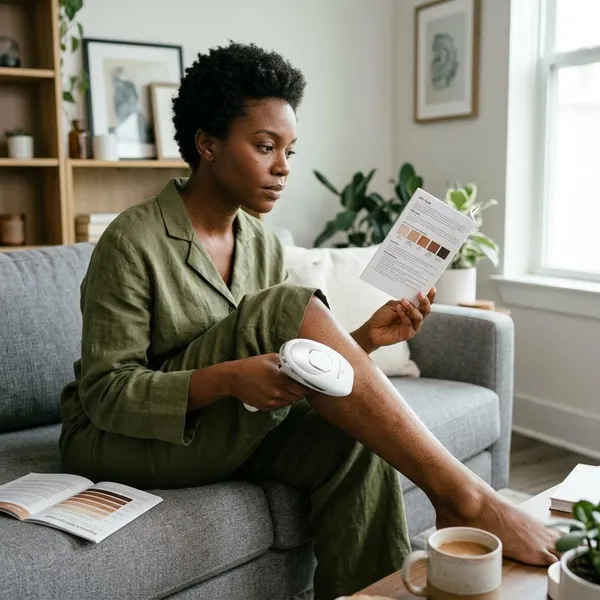
Why darker skin needs more care with IPL
IPL targets pigment, and pigment is present in both hair and skin. On darker skin, more of the light energy may be absorbed by the skin before it can act mainly on the hair, which reduces the safety margin.
More melanin absorbs more light energy
Melanin converts IPL light into heat. Ideally, that heat is concentrated around the hair, but when the surrounding skin also contains more melanin, the skin can absorb a larger share of the pulse.
That is why dark hair on lighter skin is usually the simplest home-IPL scenario. Dark hair on medium or darker skin needs a device that is specifically approved for that visible skin tone, not just a device that claims broad compatibility.
Extra heat raises the risk of skin injury
Too much heat can lead to stronger pain, lingering redness, swelling, blistering, or burns. At-home devices are designed with consumer limits, but they can still cause injury if used outside their approved range.
A very common real-life mistake is trying to make slow results happen faster. Increasing intensity too quickly or passing repeatedly over the same patch usually adds heat, not better long-term hair reduction.
Skin injury can trigger pigment changes
After irritation or a burn, skin can react by producing darker marks or, less commonly, lighter patches. These pigment changes may last much longer than the original redness.
This is especially important for areas where marks are hard to ignore, such as the face, underarms, or bikini line. If a patch test causes more than mild temporary redness, that is a stop sign rather than something to push through.
How to check if an IPL device is safe for your skin
The safest order is simple: check the treatment area first, then the device chart, then the sensor if there is one, then the patch test. Do not start with the highest setting, and do not use your general Fitzpatrick type as permission to treat every area.
- Look at the exact area: use clean, untanned skin in natural light.
- Use the device chart: compare with the brand's approved range, not a random online chart.
- Respect the sensor: a blocked flash is often a safety warning, not an inconvenience.
- Patch test first: wait for the reaction time stated in the manual before doing a full area.
- Recheck after sun exposure: your skin tone can change between seasons.
Check your untanned treatment area
Judge the skin you plan to treat, not the skin you usually use to describe yourself. If you want to treat your lower legs, check your lower legs; if you want to treat underarms, check the underarm skin itself.
Summer use is the situation where people most often get this wrong. A mild tan may not feel like a big change, but it can still increase pigment enough to make home IPL less suitable until the skin returns to its normal shade.
Match it to the device skin tone chart
The device chart is more useful than Fitzpatrick type for the final decision because it reflects the range the manufacturer allows for that model. If your skin sits close to the darkest allowed shade, choose the more cautious interpretation.
Do not copy the rules from another device. One brand may allow certain medium-brown tones while another may block them, even if both products are sold as at-home IPL devices.
Use the skin tone sensor if included
A skin tone sensor can add a helpful safety layer by lowering output or blocking flashes on areas it reads as unsuitable. It is especially useful when one body area is noticeably darker than another.
Still, the sensor is not a free pass. It cannot make unsuitable hair colors respond well, remove the effect of a tan, or cancel medical warnings in the manual.
Complete the recommended skin test
A patch test is worth doing whenever you are new to the device, changing intensity, treating a darker area, or restarting after sun exposure. Treat a small area first, then wait for the time recommended by the manual.
- Acceptable: mild, short-lived redness that settles as the manual describes.
- Concerning: strong pain, swelling, blistering, unusual heat, or marks that linger.
- Best response: stop treating that area until you know why your skin reacted.
Recheck your skin after tanning
Suitability can change after outdoor sun, tanning beds, or self-tanner. Even if a device was fine for your legs in spring, the same setting may be a poor choice after summer sun.
Self-tanner deserves special caution because it darkens the surface color the device or sensor may read. Wait until it has fully faded or been removed and your skin looks like its normal baseline before treating.
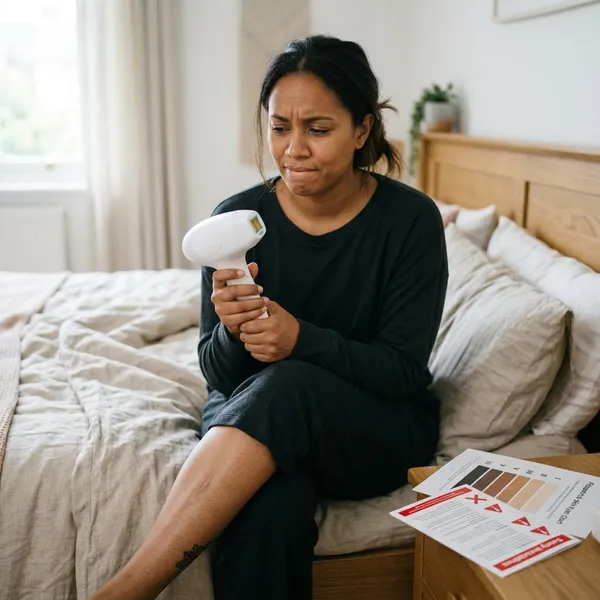
When not to use at-home IPL
There are times when the safest choice is not to treat at home. That includes skin outside the device range, blocked flashes, recent tanning or sunburn, listed contraindications, and certain dark spots in the treatment area.
For a low-risk routine, think of the manual and sensor as boundaries, not suggestions. For a higher-risk situation, such as darker skin near the chart limit or a medically sensitive skin history, professional advice is the safer next step.
Your skin falls outside the device range
Do not use the device on skin that is darker than the approved range. The risk is not just lower effectiveness; the skin itself may absorb too much heat, raising the chance of burns or discoloration.
If home IPL is not a match, it is better to look at other hair removal methods or ask a dermatologist about professional options that may be more suitable for darker skin.
Your device blocks the flash
A blocked flash should be treated as a warning until proven otherwise. It may mean poor contact, but it may also mean the device has detected a skin tone it is not designed to treat.
Check the manual for contact-position tips once. If the device still refuses to flash on the same area, skip that area rather than changing angles or pressing harder to force it.
Your skin is recently tanned or sunburned
Recently tanned skin has extra pigment, and sunburned skin is already inflamed. Both situations make IPL a bad idea until the skin has returned to its normal, calm condition.
This applies to holiday tanning, tanning beds, and gradual everyday sun exposure. If the area looks darker than your baseline, postpone treatment instead of trying to compensate with technique.
The manual lists a contraindication
Do not use the device if a contraindication in the manual applies to you. These warnings may involve photosensitizing medication, certain skin conditions, active infections, suspicious lesions, or other health factors that affect how your skin reacts to light.
If the warning is unclear, ask a pharmacist, doctor, or dermatologist before treating. A suitable skin tone does not override a medical caution.
The treatment area has restricted dark spots
Avoid flashing directly over restricted dark spots such as many moles, tattoos, permanent makeup, very dark freckles, or heavily pigmented lesions unless the manual gives a specific safe method for handling them.
If a spot is new, changing, irregular, or worrying in any way, have it checked before thinking about hair removal. IPL should never be used to work around uncertain skin changes.

Conclusion
At-home IPL is usually most straightforward for lighter Fitzpatrick ranges, possible for some medium to darker ranges with the right device, and not suitable when the treatment area falls outside the approved chart. The best practical decision is to check the exact untanned area, respect the device limits, and pause whenever tanning, sensor blocks, contraindications, or unusual skin spots make the answer uncertain.
FAQS
Is a device skin tone chart the same as Fitzpatrick type?
No. Fitzpatrick type describes sun reaction, while a device chart shows the visible skin tones that a specific IPL model allows for treatment.
Can a skin tone sensor make any skin tone safe?
No. A sensor can block or adjust treatment, but it cannot make skin outside the device's tested range safe to treat.
Should you check your face or the treatment area?
Check the treatment area. Your face, arms, legs, underarms, and bikini line can all be different shades, so the exact area matters most.
Does self-tanner affect IPL safety?
Yes. Self-tanner can make skin appear darker to the device, so wait until it has fully faded and your natural tone is visible again.