Is Home Laser Hair Removal Effective for PCOS Hair?
At-home IPL can reduce PCOS-related hair for some people, but it is usually better for slowing regrowth than for clearing it permanently. The best candidates have dark coarse hair, a skin tone approved by the device, and realistic expectations about ongoing maintenance. If your main problem is fast, dense chin or jawline hair, professional laser is often the stronger first choice.
When might home IPL be worth considering?
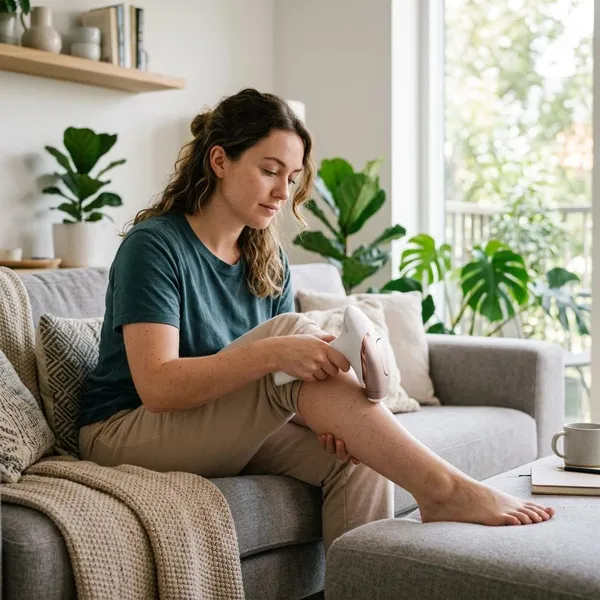
Home IPL is most worth considering when the basic match is good: dark hair, approved skin tone, approved treatment area, and patience for repeat sessions. It can be a practical option if you want more control at home or if body hair is your main concern.
Dark coarse hair
Dark, coarse hair is the best match because IPL targets pigment in the hair. Thick dark strands on areas such as the stomach, chest, chin, or jawline are more likely to respond than pale, red, grey, or very fine hairs.
A compatible skin tone
Skin tone compatibility is a safety issue, not a small technical detail. Most home IPL devices work only within a specific skin-tone range because the light can also be absorbed by pigment in the skin.
- Good match: the device chart clearly includes your skin tone and hair color.
- Borderline match: you are near the darkest approved shade or unsure how to classify your skin.
- Poor match: the manual says your skin tone is not suitable, even if the hair itself is dark.
If you fall into the borderline or poor-match group, it is safer to pause before buying or using the device, especially for facial areas where irritation or pigment changes are more visible.
Device-approved treatment areas
Only treat areas the device specifically approves. Some home devices are fine for legs or underarms but not for the face, neck, nipples, or certain bikini areas.
Realistic expectations about maintenance
Home IPL is usually a maintenance tool for PCOS, not a one-time fix. A realistic win might be shaving less often, seeing fewer thick hairs, or getting slower regrowth.
Home IPL vs professional laser for PCOS
The main difference is strength and control. Home IPL is designed for self-use, so it uses lower energy and limited settings. Professional laser can use stronger, more targeted settings and is usually better supported for PCOS-related hirsutism.
That does not mean home treatment is pointless. It means the choice should depend on how stubborn the hair is, where it grows, and how much risk you are comfortable managing yourself.
Home IPL uses lower energy
Consumer IPL devices use lower energy so they can be used at home with a wider safety margin. The trade-off is slower progress and, for some PCOS hair, weaker reduction.
Professional laser has stronger PCOS evidence
Professional laser has stronger evidence for reducing hormonally influenced hair growth than home IPL devices. Most research and clinical experience around PCOS-related hirsutism focuses on in-clinic treatments rather than consumer tools.
If your decision is mainly about cost, home IPL may be a reasonable first trial. If your decision is about getting the strongest possible reduction on visible facial hair, a clinic is usually the more evidence-backed route.
PCOS may require more treatment sessions
PCOS can make hair removal feel less predictable because hormonal signals may keep encouraging new hairs. Even when treated hairs reduce, new growth can appear later.
- Do not judge after one or two sessions. IPL and laser both work gradually.
- Track regrowth, not just smoothness. Notice whether shaving lasts longer or hair feels less coarse.
- Expect maintenance. PCOS often needs ongoing control rather than a clear finish line.
Clinics can tailor treatment to skin and hair type
A clinic can adjust the treatment based on your skin tone, hair thickness, treatment area, and reaction after each session. That flexibility matters if one area responds well but another becomes irritated or barely changes.
How to use a compatible home device
If a device is suitable for your skin, hair, and treatment area, the next priority is using it in a way that lets it work. The most common mistakes are plucking between sessions, treating too often, skipping the patch test, or giving up before there has been enough consistent use to judge the result.
Check skin and hair compatibility
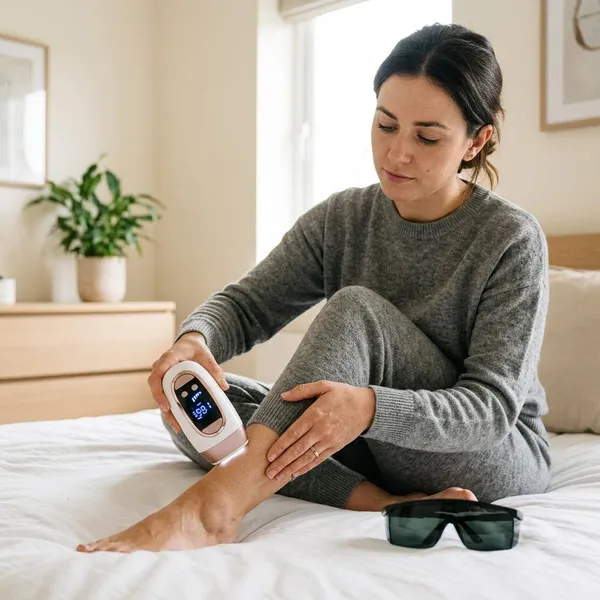
Before the first flash, compare your skin tone and hair color with the device chart in good natural light. Also check whether the exact area you want to treat is approved.
If you are unsure, do not "test it properly" on your face. Start by contacting the device maker, asking a qualified professional, or choosing a clinic consultation instead. Uncertainty is a good reason to be cautious, not a reason to increase the setting.
Shave instead of waxing or plucking
Shaving is usually the right preparation because it leaves the follicle under the skin for the light to target. Waxing, threading, and plucking remove that target and can make results harder to judge.
Patch test before full treatment
Patch test on the exact area or a nearby similar area, then wait the amount of time stated in the manual. Skin that tolerates IPL on the leg may react differently on the chin, upper lip, or bikini line.
Follow the device-specific schedule
Use the schedule for your actual device, not a routine copied from someone else. More frequent sessions do not necessarily mean faster reduction and may only add irritation.
For a fair trial, keep a small note on dates and changes: how often you shaved before, how quickly stubble returned, and whether the hair feels finer. That gives you a better measure than trying to remember whether it "seems better."
Stop if significant irritation develops
Stop using the device if you get blistering, scabbing, strong pain, lasting tenderness, or pigment changes. Mild short-term redness can happen, but anything more than that deserves a pause.
When should you consider professional laser?
Professional laser is worth considering when the hair is highly visible, dense, fast-growing, or not responding to careful home use. It is also the safer next step if your skin tone is near or outside the home device's approved range.
Persistent chin or facial hair
Persistent chin, jawline, upper-lip, or neck hair is one of the strongest reasons to look at professional laser. These areas are visible, often emotionally stressful, and commonly stubborn in PCOS.
If you are planning your mornings around shaving or checking mirrors during the day, a clinic consultation may be more useful than another round of trial-and-error at home.
Dense coarse regrowth
Dense regrowth that feels thick again soon after shaving may be too much for a lower-energy home device to control well. Home IPL might still soften the pattern, but the effort may not match the result.
Poor results from home treatment
If you have used a compatible device consistently for a few months and still see almost no change in shaving frequency, density, or hair texture, it is reasonable to move on. First rule out fixable mistakes such as plucking, skipped sessions, or treating an area not approved by the device.
If those are not the problem, the limitation may simply be the device. A professional can also tell you whether the hair is likely to respond to laser at all.
Skin-tone concerns
Skin-tone concerns are a strong reason not to guess. If your skin is close to the darkest shade on the device chart, if you tan easily, or if you have a history of dark marks after irritation, professional advice is safer.
Need for customized treatment settings
Customization matters when PCOS hair is mixed: dense on the chin, patchy on the jawline, finer on the cheeks, or paired with sensitive skin. A professional can change settings by area and adjust the plan if your skin reacts or the hair stops improving.
Home devices are simpler by design. That simplicity is convenient for low-risk use, but it becomes a drawback when the hair pattern needs more than a basic preset.
Conclusion
PCOS laser hair removal at home can be worth trying if your hair is dark and coarse, your skin tone is clearly approved, and you are comfortable treating it as ongoing maintenance. If the hair is facial, dense, fast-growing, or safety feels uncertain, professional laser is usually the more practical path. The best choice is the one that matches the real problem you are dealing with, not just the option that looks easiest to start.
FAQS
Does at-home IPL work on PCOS facial hair?
It can, but facial PCOS hair is often harder to control than body hair. If the hair is dark, coarse, and the device is approved for that facial area, you may see slower growth; if it stays dense after consistent use, a clinic is likely a better option.
Is laser hair removal permanent if you have PCOS?
Usually not fully permanent. Laser and IPL can reduce hair, but PCOS can keep triggering new growth, so maintenance sessions are common.
Can you use home IPL on PCOS chin hair?
Only if the device is approved for chin or facial use and your skin tone and hair color match its safety chart. Patch test first, avoid plucking during the trial, and stop if irritation is more than mild and short-lived.