Are Home IPL Hair Removal Devices Safe to Use?
FDA clearance and CE marking can make a home IPL device more reassuring, but neither label means the device is automatically safe for every person or every treatment area. The first thing to check is whether the claim matches the exact model you want to buy, not just the brand name, storefront, or a similar-looking device.
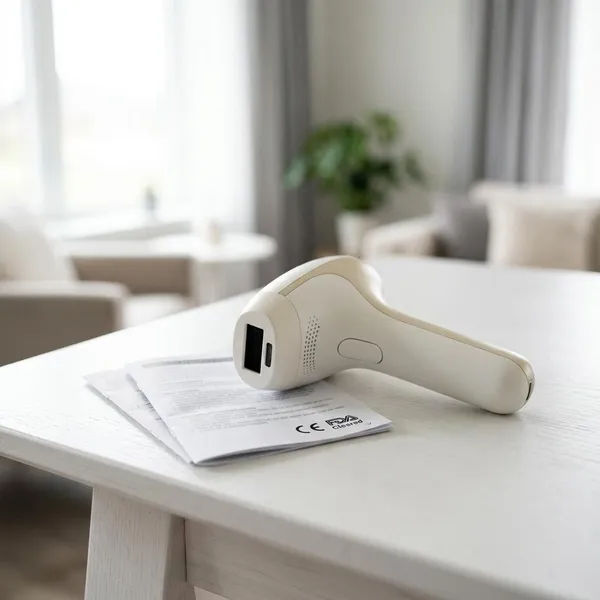
FDA clearance vs CE marking
FDA clearance and CE marking come from different systems. FDA clearance is mainly relevant when a device is marketed in the United States, while CE marking is used for products placed on the EU market under applicable European rules.
| What you are checking | FDA clearance | CE marking |
|---|---|---|
| Main market | United States | European Union |
| Most useful proof | Exact 510(k) record | EU Declaration of Conformity |
| Common weak claim | "FDA registered" without clearance details | CE logo with no matching documents |
| Buyer action | Match model, manufacturer, and intended use | Match model, manufacturer, declaration, and manual |
What FDA clearance really means
FDA wording is easy to misread because several official-sounding phrases are used in product marketing. For home IPL, "FDA cleared" is stronger than "FDA registered," but even clearance has limits. It supports a specific device and intended use; it does not remove the need for safe use at home.
A cleared device can still cause redness, irritation, burns, or pigment changes if it is used on unsuitable skin, over tattoos, near the eyes, after tanning, or at a setting the manual does not recommend.
Look for a 510(k) clearance
The clearest FDA-related proof to look for is a 510(k) number. It should lead to a public FDA record for a device used for light-based hair removal or a closely relevant intended use. Claims such as "FDA registered facility," "FDA listed," or "FDA compliant" do not mean the consumer IPL device itself has been cleared.
- Good sign: the brand shows a 510(k) number you can search.
- Weak sign: the seller only says "FDA registered."
- Red flag: the number points to a different product type or manufacturer.
Match the exact model and manufacturer
FDA clearance is not a blanket pass for every device a brand sells. Compare the model number, legal manufacturer, device name, and intended use in the FDA record with the product page, manual, and packaging photos.
What CE marking really means
CE marking is often printed so casually on consumer products that it can look like a simple trust badge. For an IPL device, it should be treated as a starting point for verification, not the final answer.
The useful question is whether the CE mark is backed by traceable paperwork and a responsible seller. A real compliance trail should connect the device, manual, manufacturer, and Declaration of Conformity without making you guess which product the documents describe.
CE shows conformity with applicable EU rules
A CE-marked IPL device should have a Declaration of Conformity, clear manufacturer details, and instructions that match the exact product. The declaration does not need to make you a regulatory expert; it simply needs to be specific enough that you can identify the device and the company responsible for it.
IPL hair removal falls under specific EU requirements
Home IPL devices are not just decorative beauty gadgets with a bright lamp. Because they deliver intense light to skin, the documentation and instructions should address safe use, restricted users, treatment areas, labeling, and foreseeable misuse.
- For summer use: look for clear warnings about recent sun exposure, tanning, and fake tan.
- For shared household use: check whether the device explains skin tone limits clearly enough for different users.
- For face use: confirm the manual allows the specific area you want to treat; never rely on product photos alone.
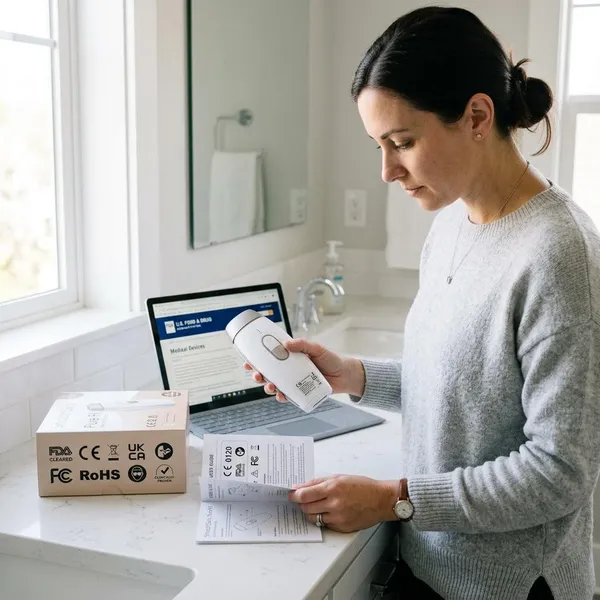
How to verify IPL safety claims
The safest buying habit is to verify the claim before you compare price, flash count, app features, or design. Start with the regulatory proof, then move to the safety features and manual. If the basic documents do not match, the nicer extras matter much less.
Use consistency as your main test. The model, manufacturer, intended use, and instructions should line up across the product page, official website, documents, and packaging.
Search the FDA device database
Use the FDA device database when a seller claims FDA clearance. Search by the 510(k) number if available, then cross-check the device name, applicant or manufacturer, and intended use. If you only have the brand name, search that too, but expect less reliable results because storefront names and legal manufacturer names may differ.
Check the exact 510(k) number
The 510(k) number is the fastest way to separate a real claim from vague FDA language. Once you find the record, ask whether it supports the actual consumer IPL device being sold, not a related salon machine, accessory, or older model.
Review the EU Declaration of Conformity
For a CE-marked IPL device, ask for the EU Declaration of Conformity and read it with one goal: matching. The product name, model number, manufacturer, and date should make sense next to the device you plan to buy.
- Does the declaration name the same model?
- Does the legal manufacturer match the packaging or manual?
- Is the document specific to the device, not a generic template?
- Can the seller provide it without avoiding the question?
Confirm the model matches the documents
This is the step that catches many weak claims. Write down the exact model code from the listing, including letters and suffixes, then compare it with the manual, packaging photos, FDA record, or CE documents.
Which IPL safety features matter
Regulatory documents tell you whether a device has a traceable compliance claim. Built-in safety features tell you how forgiving the device may be during normal home use. Both matter, but they solve different problems.
Skin tone sensing
Skin tone sensing helps the device decide whether a treatment area is suitable before flashing or whether the intensity should be limited. This is important because IPL targets pigment, and darker or recently tanned skin can absorb more light energy than intended.
For someone who only treats pale winter skin, a manual skin tone chart may feel manageable. For year-round use, shared use, or anyone who tans easily, automatic sensing is a more meaningful safeguard because it reduces the chance of relying on a quick guess in poor lighting.
Full skin-contact detection
Full skin-contact detection should stop the flash unless the treatment window sits properly against the skin. It helps prevent flashes into open air and can make treatment more controlled on curved areas such as underarms, knees, or ankles.
Controlled flash output
Controlled flash output means the device delivers light in a measured, consistent way rather than relying on aggressive power claims. Look for clear intensity levels, automatic adjustment where available, and instructions that explain when to reduce the setting.
- Start lower if the manual gives a range and you are unsure.
- Stop treating if discomfort feels sharp rather than warm or mildly snappy.
- Do not repeat flashes over the same spot just because you missed a patch nearby.
Clear treatment warnings
Good warnings are not legal filler. They help you decide when not to use the device. The manual should clearly mention unsuitable skin tones, recent tanning, tattoos, dark moles, broken or irritated skin, photosensitizing medication, and restricted treatment areas.
Reliable eye-safety design
Eye safety depends on both design and user behavior. Look for contact detection, a treatment window that sits flush against the skin, and clear instructions for any permitted facial use. Do not use an IPL device around the eyes unless the manual explicitly allows the exact area and method.
For upper-lip or jawline use, this detail matters more than convenience. A device may be fine for legs but still require stricter positioning and warnings on the face.
Conclusion
A home IPL device is easier to trust when the paperwork and the design both hold up: a matching FDA 510(k) record if FDA clearance is claimed, a model-specific Declaration of Conformity if CE marking is used, and safety features that reduce common home-use mistakes. If a seller cannot connect the claim to the exact model, or the manual is vague about skin tone, tanning, tattoos, and eye-area use, it is smarter to keep looking than to treat certification language as a shortcut.
FAQS
Does CE marking guarantee an IPL device is safe?
No. CE marking shows conformity with applicable EU requirements, but it does not prove the device is suitable for your skin tone, treatment area, or usage habits.
Is FDA registration the same as FDA clearance?
No. FDA registration is not the same as FDA clearance; for a home IPL device, the more useful claim is a searchable 510(k) clearance tied to the exact model and intended use.
Can a certified IPL device still cause burns?
Yes. Burns or pigment changes can still happen if the device is used on tanned skin, unsuitable skin tones, tattoos, irritated skin, or with settings that do not match the manual.